MarkSpec Model Reference
MarkSpec parses Markdown and source-file doc comments into a structured item graph — a directed graph of typed, identified items connected by typed trace relations. This reference book is the complete, standalone description of that model.
Two-layer architecture
The model is divided into two layers:
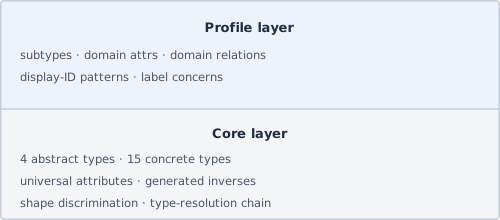
Core layer — built into the toolchain. Four abstract types and fifteen
concrete types cover the vocabulary needed for any traceable documentation
project. Core also defines the universal attributes (Id, Type, Labels, …),
the shape-discrimination rule (ULID vs. URI), and the 8-step type-resolution
chain. Core behavior is version-locked and cannot be overridden by profiles.
Profile layer — domain-specific extensions declared in a markspec.yaml
manifest. A profile can add subtypes (e.g., requirement extends Requirement
with a display-ID pattern), domain attributes (e.g., ASIL, Priority), domain
relations (e.g., Mitigated-by), label concerns, and document conventions. A
project activates profiles via .markspec.yaml. When no profile is configured
the toolchain runs in core-only mode.
Key concepts
Entry — the atomic unit of the model. Every entry has:
- A display ID — human-readable, e.g.,
SRS_BRK_0107 - A title — the first line of the Markdown list item
- A body — prose paragraphs describing the item
- A trailer block — indented key-value attributes (
Id:,Type:,Labels:, …)
Shape — determined solely by the Id: value. Exactly two shapes exist:
- Authored —
Id:is a bare ULID (01HGW2Q8MNP3RSTVWXYZABCDEF). The item originated in this project; ULIDs are assigned bymarkspec fmt. - Reference —
Id:is a URI with scheme (urn:,doi:,pkg:,https:). The item is an external standard, package, or open-source dependency.
Type — resolved from the Type: trailer attribute via an 8-step chain.
Profiles declare concrete subtypes that extends: a core type. The final
fallback is Item. Type and shape are orthogonal — any type can be either
shape.
Relation — a typed, directed edge in the trace graph written as a trailer
attribute (Satisfies: SYS_BRK_0042). MarkSpec generates inverse edges
automatically in the compiled output (Satisfied-by). The author only writes
the forward edge.
Reading guide
| Chapter | What it covers |
|---|---|
| Entry format | Syntax and anatomy of entry blocks; the two shapes; in-source entries |
| Type taxonomy | The 4 abstract and 15 concrete types; the type-resolution chain; profile subtypes |
| Attributes | Universal attributes; per-type typical attributes; multi-value rules |
| Trace relations | Core relations; generated inverses; the trace graph |
| Profiles and extensions | Profile manifests; the extends chain; core-only mode; bundled profiles |
| Annex A — Compile output | The /api/ directory layout; manifest, entry, and edge schemas; federation |